Saturday, 28 January 2023

More approaches to design of covalent inhibitors of SARS-CoV-2 main protease

<< previous |

I’ll pick up from the previous post on design covalent inhibitors of SARS-CoV-2 main protease (structure and chart numbering follows from there). As noted previously, I really think that you need to exploit conserved structural features, such as the catalytic residues and the oxyanion hole, if you’re genuinely concerned about resistance and I do consider it a serious error to make a virtue out of non-covalency. As in the previous post, I've linked designs to the original Covid Moonshot submissions whenever possible. 

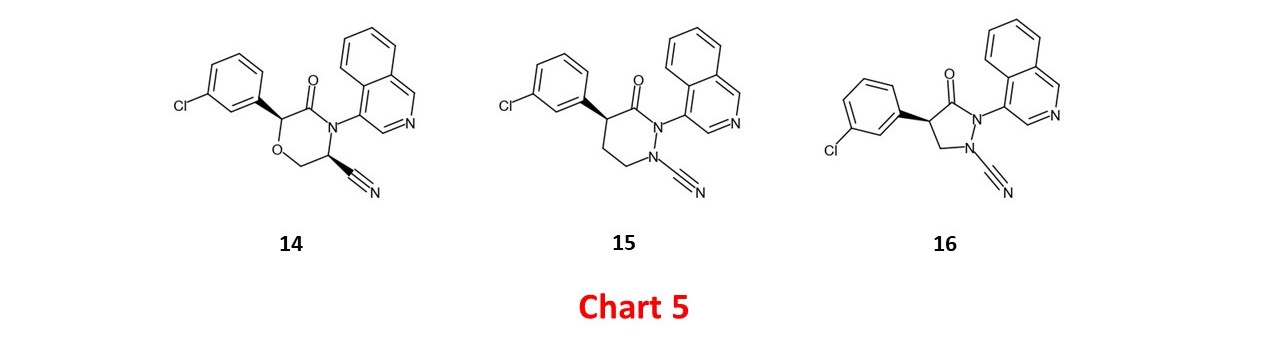
I’ll kick the post off with 14 (Chart 5) which replaces a methylene in the lactam ring of 10 (Chart 4 in previous post) with oxygen. This structural transformation results in 0.8 log unit reduction in lipophilicity (at least according to the algorithm used for the Covid Moonshot) and might also simplify the synthesis.
Designs 15 and 16 (also in Chart 5) link the nitrile warhead from nitrogen rather than carbon and this structural transformation eliminates a chiral centre in each of 10 and 11 (Chart 4 in previous post) and may be beneficial for affinity (see discussion around 8 and 9 in Chart 3 of the previous post). In substituted hydrazine derivatives, the nitrogen lone pairs (or the π-systems which the nitrogens are in) tend to avoid each other and so I’d expect nitrile warheads of 15 and 16 to adopt axial orientations. I’d anticipate that the nitrile warhead will be directed toward the catalytic cysteine for 15 but away from the catalytic cysteine for 16 and I favor the former for this for this reason. It's also worth mentioning that even if the nitrile is directed away from the catalytic cysteine it may occupy the oxyanion hole.

I’ll finish with couple of designs based on aromatic sulfur that are shown in Chart 6. Design 17 was originally submitted by Vladas Oleinikovas although I’ll also link my resubmission of this design because the notes include a detailed discussion of a design rationale along with a proposed binding mode. My view is that the catalytic cysteine could get within striking distance of the ring sulfur (which can function as a chalcogen-bond donor and potentially even an electrophile). Although 2,1-benzothiazole is not obviously electrophilic, it’s worth noting that acetylene linked by saturated carbon can replace the nitrile as an electrophilic warhead (this isosteric replacement leads to irreversible inhibition as discussed in this article). I’ve also included 18 which replaces 2,1-benzothiazole with (what I’d assume is) a more electrophilic heterocycle. I would anticipate that any covalent inhibition by these compounds will be irreversible.


Wednesday, 25 January 2023

Assessment of chemical probes: response to Practical Fragments

<< previous | next >>

I had originally intended to look at permeability in this post but I do need to respond to Dan Erlanson’s post at Practical Fragments. I see Dan’s position (“everything is an artifact until proven otherwise”) as actually very similar to my position (“chemical probes will have to satisfy the same set of acceptability criteria whether or not they trigger structural alerts”) and we’re both saying that you need to perform the necessary measurements if you’re going to claim that a compound is acceptable for use as a chemical probe. Where Dan’s and my respective positions appear to diverge is that I consider structural alerts based on primary screening output (i.e., % response when assayed at a single concentration) to be of minimal value for assessment of optimized chemical probes. My comment on the “The Ecstasy and Agony of Assay Interference Compounds” editorial should make this position clear. 

Thursday, 19 January 2023

Some approaches to design of covalent inhibitors of SARS-CoV-2 main protease

<< previous | next >>

I last posted on Covid-19 early in 2021 and quite a lot has happened since then. Specifically, a number of vaccines are now available (I received my first dose of AstraZeneca CoviShield in May 2021 while still stranded in Trinidad) and paxlovid has been approved for use as a Covid-19 treatment (Derek describes his experiences taking paxlovid in this post).  The active ingredient of paxlovid is the SARS-CoV-2 main protease inhibitor nirmatrelvir and the ritonavir with which it is dosed serves only to reduce clearance of nirmatrelvir by inhibiting metabolic enzymes. In the current post, I’ll be looking at covalent inhibition of SARS-CoV-2 main protease with a specific focus on reversibility and here are some notes that I whipped up as a contribution to the Covid Moonshot.

Nirmatrelvir (1) is shown in Chart 1 along with SARS-CoV-2 main protease inhibitors from the Covid Moonshot (2), a group of (mainly) Sweden-based academic researchers (3) and Yale University (4).  Nirmatrelvir incorporates a nitrile group that forms a covalent bond with the catalytic cysteine and the other inhibitors bind non-covalently to the target. The first example of a nitrile-based cysteine protease inhibitor that I’m aware of was published over half a century ago and the nitrile warhead has since proved popular with designers of cysteine protease inhibitors (it has a small steric footprint and is not generally associated with metabolic lability or chemical instability). Furthermore, covalent bond formation between the thiol of a catalytic cysteine and the carbon of the nitrile warhead is typically reversible. Here’s a recent review on the nitrile group in covalent inhibitor design and this comparative study of electrophilic warheads may also be of interest.

At this point, we should be thinking about the directions in which design of SARS-CoV-2 main protease inhibitors needs to go. Two directions I see as potentially productive are dose reduction (a course of paxlovid treatment consists of two 150 mg nirmatrelvir tablets and one 100 mg ritonavir tablet taken twice daily for five days) and countering resistance (here’s a relevant article).

Two tactics for achieving a lower therapeutic dose are to increase affinity and reduce clearance. Dose prediction is not as easy as you might think because the predictions are typically very sensitive to input parameters. For example, a two-fold difference in IC50 would often be regarded as within normal assay variation by medicinal chemists but development scientists and clinicians would view doses of 300 mg and 600 mg very differently. 

Excessive clearance is a problem from the perspective of achieving adequate exposure and I'd also anticipate greater variability in exposure between patients when clearance is high. Clearance is clearly an issue for nirmatrelvir because it needs be co-dosed with ritonavir (to inhibit metabolic enzymes) and this has implications for patients taking other medications. Nirmatrelvir lacks aromatic rings and deuteration is an obvious tactic to reduce metabolic lability (although cost of goods is likely to be more of an issue than for a cancer medicine that you'll need to take out a second mortgage for). I would anticipate that bicyclo[1.1.1]pentanyl will be less prone to metabolism than t-butyl (CH bonds tend to be stronger in strained rings and for bridgehead CHs) and the binding mode suggests that this replacement could be accommodated. 

Details of resistance to nirmatrelvir (P2022 | Z2022) are starting to emerge and this information should be certainly be used in design and to assess other structural series. Nevertheless, if you’re genuinely concerned about potential for resistance then you really can’t afford to ignore conserved structural features in the target such as the catalytic residues (cysteine and histidine) and the oxyanion hole. I would also anticipate that the risk of resistance will increase with the spatial extent of the inhibitor.

This post is about covalent inhibitors. Although I’m pleasantly surprised by the potencies achieved for non-covalent SARS-Cov-2 Main Protease inhibitors, I consider making a virtue of non-covalent inhibition to be a serious error. Binding of covalent inhibitors to their targets can be reversible  or irreversible and, in the context of design, reversible covalent inhibitors have a lot more in common with non-covalent inhibitors than with irreversible covalent inhibitors (for example, you can't generally use mass spectroscopy to screen covalent fragments that bind reversibly). In the context of drug design, covalent bonds have much more stringent geometric requirements than non-covalent interactions such as hydrogen bonds.   

I generally favor reversible binding when targeting catalytic cysteines as discussed in these notes and this article. It is typically less difficult to design reversible covalent inhibitors to target a catalytic cysteine than it is to design irreversible covalent inhibitors because you can use crystal structures of protein-ligand complexes just as you would for non-covalent inhibitors. In contrast, the crystal of a protein-ligand complex (the reaction ‘product’) is not especially relevant in design of irreversible inhibitors because target engagement is under kinetic rather than thermodynamic control and the more relevant transition state models must therefore be generated computationally. Furthermore, assays for irreversible inhibitors are more complex, and assessment of functional selectivity and safety is more difficult than for reversible inhibitors. All that said, however, I’m certainly not of the view that irreversible inhibitors are inherently inferior to reversible inhibitors for targeting catalytic cysteines. This is also a good point to mention an article which shows how isosteric replacement (with an alkyne) of the nitrile warhead of the reversible cathepsin K inhibitor odanacatib results in an irreversible inhibitor (the article is particularly relevant if you’re interested in chemical probes for cysteine proteases).

I contributed some designs for reversible covalent inhibitors to the Covid Moonshot and it may be helpful to discuss some of them. Each design was intended to link the nitrile warhead to the ‘3-aminopyridine-like’ scaffold used in the Covid Moonshot which means that the designs all use a heteroaromatic P1 group (typically isoquinoline linked at C4) rather than the chiral P1 group (pyrrolidinone linked at C3) used for nirmatrelvir and a number of other SARS-CoV-2 main protease inhibitors. The ‘3-aminopyridine-like’ scaffold lacks essential hydrogen bond donors (elimination of hydrogen bond donors is suggested as a tactic for increasing aqueous solubility in this article). One of the cool things about the way the Covid Moonshot was set up is that I can link designs as they were originally submitted (often with a detailed rationale and proposed binding mode).

The most direct way to link a nitrile to the ‘3-aminopyridine-like’ scaffold is with methylene (5, Chart 2) but there is a problem with this approach because substituting anilides (and their aza-analogs) on nitrogen with sp3 carbon inverts the cis/trans geometrical preference of the anilides (I discussed the design implications of this in these notes).  This implies that binding of 5 to the target is expected to incur a conformational energy penalty and it is significant that N-methylation of 6 results in a large reduction in potency. Although 5 was inactive in the enzyme inhibition assay, I think that it would still be worth seeing if covalent bond formation can be observed by crystallography for this compound.

However, you won’t invert cis/trans geometrical preference if you substitute an anilide nitrogen with nitrogen rather than sp3 carbon (Chart 3). This was the basis for submitting 8, which is related to azapeptide nitriles, as a design.  Azapeptide nitriles [L2008 | Y2012 | L2019 | B2022] are typically more potent than the corresponding peptide nitriles and, to be honest, this remains something of a mystery to me (one possibility is that the imine nitrogen of the azapeptide nitrile adduct is more basic than that of the corresponding peptide nitrile adduct and is predominantly protonated under assay conditions). I see cyanohydrazines and cyanamides as functional groups that would be worth representing in fragment libraries if you want to target catalytic cysteine residues and I’ll point you toward a relevant crystal structure. The acyclic hydrazine and cyanamide substructures in 8 trigger structural alerts although there are approved drugs that incorporate acyclic hydrazine (atazanavir | bumadizone | gliclazidegoserelin | isocarboxazid | isoniazid) and N-cyano (cimetidine) substructures. The basis for these structural alerts is obscure and it’s worth noting that 8 is incorrectly flagged as an enamine and having a nitrogen-oxygen single bond. As a cautionary tale on structural alerts, I’ll refer you to this comment in which I read the riot act (i.e., the JMC guidelines for authors) to a number of ACS journal EiCs Nevertheless, I’d still worry about the presence of an acyclic hydrazine substructure although these concerns would be eased if each nitrogen atom was bonded to an electron-withdrawing group, as is the case for 8, and all NHs were capped (see 9).


An alternative tactic to counter inversion of the cis/trans geometrical preference is to lock the conformation with a ring and designs 10 and 11 (Chart 4) can be seen as 'hybrids' of 5 with 12 and 13 respectively (in fragment-based design, hybridization is usually referred to as fragment merging). The effect of the conformational lock can be clearly seen since 12 and 13 are essentially equipotent with 6 (the primary reason for proposing 12 and 13 as designs was actually to present the nitrile warhead to the catalytic cysteine). A substituent on carbon next to a lactam nitrogen tends to adopt an axial orientation and I’d anticipate that 10 will be less prone to epimerization than 11. Although I'm unaware of nitriles being deployed on cyclic amine substructures for cysteine protease inhibition, the structures of the DPP-4 inhibitors saxagliptin and vildagliptin are relevant.


This is a good point at which to wrap up. If cysteine protease inhibition is a key component of pandemic preparedness strategy then you really do need to be thinking about covalent inhibition.  I'll be looking at some more design themes for covalent inhibitors of SARS-CoV-2 in the next Covid post.
Monday, 2 January 2023

Assessment of chemical probes

| next >>

I’ll be taking a look at some of the criteria, specifically structural alerts, by which chemical probes are assessed and here’s the link to the Chemical Probes Portal. Before getting into the post there are a couple of points that I need to stress. First, structural alerts derived from analysis of screening hits (defined as responses that exceed a threshold when assayed at a particular concentration) are not necessarily useful for assessing higher affinity compounds for which concentration responses have been determined. Second, chemical probes will have to satisfy the same set of acceptability criteria whether or not they trigger structural alerts.      

I’ll start by commenting on “A conversation on using chemical probes to study protein function in cells and organisms” that was recently published in Nature Communications since it was this article that triggered the blog post.  I consider most of the views expressed in the in the article to be sound although I disagree with much of what is stated in the following paragraph:

“The first essential thing that needs to be done is to eliminate the really bad nuisance compounds, which can have problematic behavior—like being non-specifically very reactive with proteins; forming colloidal aggregates that non-specifically adsorb and inactivate proteins; exerting toxicity toward cells, for example through a membrane damaging effect called phospholipidosis; or exhibiting spectral or fluorescence properties that interfere with the biological assay read-out. These undesirable compounds are often referred to as Pan Assay Interference or PAINS compounds, as highlighted by Jonathan Baell [4]. There are software filters or algorithms available that should be used routinely to identify any risk of such chemical promiscuity and simple lab assays should be run to check for the various problematic properties we mentioned. Such compounds should never be considered further or used as chemical probes. They should be excluded from compound libraries. Yet many are sold by commercial vendors as chemical probes and widely used.”

In 2017 a number of ACS journals simultaneously published “The Ecstasy and Agony of Assay Interference Compounds” editorial and I believe that a number of points raised in a comment on this editorial are still relevant to dealing with nuisance compounds. In the comment, I classified bad behavior of screening ‘actives’ as Type 1 (compound hits in the assay but does not affect target function) and Type 2 (compound affects target function through an undesirable mechanism of action). These are two very different problems and each requires very different solutions. Type 1 behavior, which can also be described as interference with read-out, is primarily a problem from the perspective of analysis of high-throughput screening (HTS) output because you don’t know whether observed ‘activity’ is real or not. From the perspective of probe promiscuity, Type 1 behavior is much less of a problem than Type 2 behavior because the ‘activity’ is not real. If you’re trying to decide whether a potential chemical probe is acceptable then genuine activity at 50 nM against another protein is going to hurt a whole lot more than responses of >50% in several assays at a test concentration of 10 μM. 

It is asserted in the conversation that there are “software filters or algorithms available that should be used routinely to identify any risk of such chemical promiscuity”. When recommending their use of predictive models for assessment of potential probes, it’s important to be aware of their inherent limitations. Specifically, models derived from analysis of data have applicability domains that are imposed by the data used to build the models. For example, PAINS filters were derived from analysis of the output of six screens that all use the same read-out (AlphaScreen) and this limits the applicability domain of the PAINS filter model to prediction of frequent-hitter behavior in AlphaScreen assays. It is asserted in the conversation that commercial vendors are selling compounds as chemical probes that are unfit for purpose and I strongly recommend that anybody making such assertions should carefully examine the supporting evidence.  I would argue that sharing structural features with compounds (for which structures that have not been disclosed) that have been observed to exhibit frequent-hitter behavior when screened at a single concentration (e.g., 10 μM) would not credibly support an assertion that a compound is unsuitable for use as a chemical probe. A specific criticism I would make of the way that structural alerts (especially those derived using proprietary data) are used is that it is sometimes suggested, for example in the ACS assay interference editorial, that HTS hits that don’t trigger structural alerts can be checked less thoroughly than hits that do trigger structural alerts.

The Information Centre of the Chemical Probes Portal includes a “Toxicophores and PAINS Alerts” section in which it is correctly stated that “the presence of the toxicophore or PAINS substructures within the chemical structure of a compound does not necessarily mean that it will be non-specifically active or toxic, or give rise to assay interference”. The “Toxicophores and PAINS Alerts” section might work better as a “Structural Alerts” section and the toxicophores citation appears to be incorrect (reference 10 actually cites an article on toxicity risks associated with excessive lipophilicity).  If doing this, I would recommend saying something about the applicability domains of any structural alerts that are highlighted and considering the inclusion of Aggregator Advisor (link to article)  and BadApple (here's link to article)  

Alternatively, it might be an idea to create separate “Nuisance Compounds” and “Toxicophores” sections because these are very different problems. I would generally recommend the use of the term “nuisance compounds” since PAINS and colloidal aggregators are sometimes treated as separate categories of bad actor, as is the case in the ACS assay interference editorial, and the criteria for labelling compounds as PAINS are ambiguous.  It would certainly be useful to include some reviews on assay interference, such as this one, in a “Nuisance Compounds” section. I quite like this article by former colleagues which shows how interference with read-out can be assessed and even corrected for.  As for a “Structural Alerts” section, the applicability domains of any predictive models should be indicated so people don’t end up using models that have been trained using hits from screening at 10 μM to assess probes with 20 nM affinity.

This is a good point at which to wrap up and it’s worth stressing that the essence of the criticism of PAINS filters is simply that the rhetoric is not supported by the data. Those like me who are critical of the way that PAINS filters are used are certainly not suggesting that screening hits all smell of roses (back in 1995 I used the Daylight toolkits to build the SMARTS-matching software that was used in the Zeneca ‘de-crapper’ and colleagues also created the Flush software) nor are we denying that assay interference is a serious problem. Although I believe that it is certainly helpful to have scientists who have worked with HTS data share their experiences and opinions with respect to hit quality, I would argue that there are dangers in giving such opinions too much weight (this article may be of interest) especially when data that might be used to justify the opinions are proprietary. Specifically, I would strongly advise against making statements that a compound is unfit for use as a chemical probe unless the assertion is supported by measured data in the public domain for the compound in question.

I’ll leave it there for now. In the next post on chemical probes, I’ll be taking a look at permeability.

Sunday, 24 July 2022

HB Donor Fragment Selection Themes

[This post was updated on 11-Dec-2024 to reflect the publication of the 'HBDs in drug design' preprint as the K2022 article]

In this post I’ll look at a couple of fragment selection themes with a hydrogen bond donor (HBD) focus. The material has been taken from the recent ‘HBDs in drug design’ preprint (HBD3; this would subsequently be published as the K2022 article) which introduced the term ‘hydrogen bond donor-acceptor asymmetry’ and suggested that we need to think differently about HBDs and hydrogen bond acceptors (HBAs) in drug design. One example of these hydrogen bond donor-acceptor asymmetries is that HBAs are typically more strongly solvated than HBDs in aqueous media and this is especially relevant to lead optimization (as shown in the graphical abstract for HBD3 below). 

However, this post is about fragment selection, rather than fixing ADME, and so I’ll say something about differences between HBDs and HBAs in the context of binding to targets. Let’s suppose that you’d like to exploit an HBD in the binding site of your target. All you need to do is place an HBA at a point in space where it can form a good hydrogen bond (taking care to address issues like steric footprint and conformational energy) and you’ve got it sorted. However, life is not quite so simple if you’re trying to exploit an HBA in the binding site because the HBD (e.g., amide NH) that you present to it will almost invariably be accompanied by an HBA (e.g., amide carbonyl O). In contrast, it is relatively easy to design an HBA (e.g., pyridine N) into a ligand structure that is not accompanied by an HBD.   

In HBD3, I describe the HBA that accompanies pretty much every neutral HBD as ‘co-occurring’. The problem for designers is that the co-occurring HBA, which is likely to come with a larger desolvation penalty than that for the HBD, needs to be accommodated and this places constraints on design. It’s also more difficult to achieve ‘line-of-sight’ access with HBDs than is the case for HBAs (you’re likely to need line-of-sight access when targeting a polar atom at the bottom of a relatively narrow binding pocket). The following figure should give you a better idea of what I’m getting at and let’s assume that we’re trying to donate an HB to HBA sitting at the bottom of a narrow and otherwise non-polar binding pocket. Although each of the three structures has appropriate geometry for line-of-sight access, things are not likely to end well if you try to exploit this line-of-sight access in a real-life design situation.

Let’s start with the phenol and, although not pertinent to this discussion, it’s worth mentioning that hydroxyl groups are prone to conjugation in phase 2 metabolism (drugs get hydroxylated in phase 1 metabolism in order to facilitate clearance). Donation of an HB by a ligand hydroxyl to a target HBA also brings the hydroxyl oxygen (the co-occurring HBA) into proximity with the molecular surface of the target. This increases the likelihood of an energetic penalty resulting from desolvation of the phenolic oxygen. One subtle point is that donation of an HB by the phenolic hydroxyl increases the HB basicity of the oxygen which effectively increases the energetic cost of desolvating it.

The co-occuring HBA of the primary amide is an even bigger problem than for phenol because the high polarity of the carbonyl oxygen means that it carries a large desolvation penalty (bad news if you’re trying to hit an HBA at the bottom of a narrow and otherwise non-polar binding pocket). If this is not enough of a problem, you also need to worry about desolvation penalties associated with the second HBD (the primary amide has two HBDs and methyl-capping will take out the one that you need for hitting that HBA at the bottom of the binding pocket). As Lady Bracknell might have observed, “One desolvated polar atom may be regarded as a misfortune; to lose solvation of two polar atoms looks like carelessness”.

The last of the trio of structures is pyrazole linked at C4 and this avoids problems that might result from biasing the tautomeric preference. Pyrazole is a great warhead if you’re targeting a proximal HBD and HBA (as is the case when trying to hit a kinase hinge). However, pyrazole’s HBA may become a liability when trying to hit the HBA at the bottom of that otherwise non-polar binding pocket. Why not just take out pyrazole’s HBA, you might ask? The problem is that pyrroles are very electron rich and tend to be quite reactive.  One tactic is to move the co-occurring HBA from the ring to the linker (1 and 2) in a way that makes the linker electron-withdrawing and pray for a less destabilizing contact between the co-occurring HBA and the binding site. Alternatively, you can take out the co-occurring HBA and modify the linker to make it more electron-withdrawing (3). I’ve included Hammett σ values in the graphic and these will give you an idea how the substituents vary in their ability to suck electron density out of the pyrrole ring (beneficial both for making the pyrrole ring more rugged and increasing the HB acidity of its NH HBD).  I see these fragments as being of about the right size to be screened crystallographically but you might want something a bit larger than methyl if you’re using another detection method.

If you’re designing (or trying to improve the coverage of) a fragment library then another selection theme that you might want to think about is fragments that can present a high ‘density’ of HBDs to a target while minimizing the number of co-occurring HBAs. One way to do this is to use the guanidine substructure although this will cause some medicinal chemists to roll their eyes (concerns about permeability) while Ro3’s adherents would be likely to denounce you for heresy (actually not such a bad thing and I think that the late, great Denis Healey might have likened this to “being savaged by a dead sheep”). Guanidine itself is extremely basic (pKa = 13.6 | ref) which means very little of the neutral form for diffusing across membranes. However, the pKa of guanidine is also extremely sensitive to substitution and a number of approved drugs incorporate this substructure. I should also point out that, even in the neutral form of guanidine, the amide-like nitrogen atoms do not function as HBAs (even though they’d be counted as such when applying Ro5).

I’ve made a small selection of substituted guanidines that I think may of interest for screening as fragments. The pKa values that I quote in this post are from an article by two former colleagues (Peter Taylor and Alan Wait who are sadly both deceased) and this is an excellent source of measured guanidine pKa values.   Two of these (4 and 5) will be predominantly protonated at neutral pH although there’ll still be a significant amount of the neutral form that you’ll need for permeability. The other two guanidines will be predominantly neutral at neutral pH although 6 is sufficiently basic to protonate in lysosomes.  As for the pyrroles, I see these as about the right size to be screened crystallographically but you might want something a bit bigger than methyl if you plan to use a different detection method.


Friday, 1 April 2022

Enthalpic fragments

<< previous || next >>

Enthalpy-driven binding has been presented as a rationale for screening fragments although some have argued that thermodynamic signature is actually a 'red herring' in the context of drug discovery.  Binding of a ligand grown from a fragment hit incurs a translational entropy penalty that is similar to that of the original fragment hit and it is therefore it is hardly surprising that synthetic elaboration results in binding that is more driven by entropy.

A recent collaborative study between researchers in the Budapest Enthalpomics Group (BEG) and Prof Wilhelmina Wiplasch, well known for her seminal study ‘The Ecstasy and Agony of Recreational PAINS’, shows this view to be hopelessly naïve. The mathematical treatment used in the study is formidable and was originally developed by Prof Wiplasch during a sabbatical at the Port-au-Prince Institute of Biogerontology. Briefly, deep learning was used to model the time-dependent covariance and kurtosis of the polarizability tensor for a series of rhodanines, showing that the enthalpic nature of fragment binding is caused by their greater ligand efficiencies. “This model comprehensively outperforms all competitors”, explains Group Leader Prof Kígyó Olaj, “and we have shown for the very first time that the Sackur-Tetrode equation can be safely consigned to the dustbin of History”.

Tuesday, 12 January 2021

Tom Lehrer's guide to design of SARS-CoV-3 main protease inhibitors for treatment of COVID-32

<< previous || next >>

It’s been ages since my last COVID-19 post (How not to repurpose a 'drug') and I’ll kick blogging off for 2021 with a follow up to an even older post (SARS-CoV-2 main protease. Crowdsourcing, peptidomimetics and fragments). I consider it unlikely that a SARS-CoV-2 main protease inhibitor, designed from scratch, will be available in time to have real impact on the current pandemic (in saying this, I’m making the huge assumption that defeat does not get snatched from the jaws of victory on the vaccination front). While many grinning Lean Six Sigma ‘belts’ (and their synchronously smiling allies in Human Resources) would denounce this as negative and defeatist, what I’m really getting at is that we need to think about targeting SARS-CoV-3 main protease when designing inhibitors for SARS-CoV-2 main protease. As Tom Lehrer advises in the intro to So Long, Mom, “If any songs are going to come from World War III, we better start writing them now”.

Happy New Year (this orchid opened during night of Dec 31/Jan 1)

If we’re designing a SARS-CoV-2 main protease inhibitor to also hit SARS-CoV-3 main protease then it’d be a good idea to engineer it to have greater affinity than necessary for the current target. In the fourth of his rules for air fighting, ‘Sailor’ Malan (readers may also be interested in his insights into fragment screening library design) asserts that “height gives you the initiative” which can be adapted for drug design as “affinity gives you the initiative”.  We should anticipate that inhibitors optimized against the current target will have lower affinity for the future target(s) although it’s obviously not a problem if this proves not to be the case. In any case, high affinity allows you to use a lower dose and that’s an important consideration if you’re planning for healthy people such as nurses and doctors to take the drug prophylactically in order to remain healthy. For a SARS-CoV-2 main protease inhibitor, I’d be looking at a target affinity of 1 nM (or better) which I believe would be achievable without causing too many self-appointed arbiters of 'compound quality' to spit feathers. Pfizer began a phase I study of the SARS-CoV-2 main protease inhibitor PF-00835321 (Ki = 0.27 nM; dosed intravenously as the phosphate pro-drug PF-07304814) in September 2020 although this compound had actually come from a discontinued SARS-CoV project. 

If we want to maximize the chances that a SARS-CoV-2 main protease inhibitor will exhibit comparative affinity for SARS-CoV-3 (or even SARS-CoV-4) then we need to exploit protein structural features that are likely to be conserved between the different main proteases. This points to milking as much activity as possible out of the core substructure of the inhibitor as a design strategy. With this in mind, I suggest that we really do need to exploit the catalytic cysteine if we’re serious about treating COVID-32 (or worried about SARS-CoV-2 main protease mutations). 

In drug design, we typically exploit a catalytic cysteine by forming a covalent bond between the thiol sulfur and an electrophilic atom in the molecular structure of the inhibitor (PF-00835321 uses the carbon of a carbonyl group to engage the catalytic cysteine). The functional group containing the electrophilic atom is commonly referred to as a “warhead” and covalent bond formation between cysteine can either be reversible or irreversible. Geometric constraints associated with covalent bond formation are typically a lot more stringent than for hydrogen bonds and you’ll make life much easier for yourself by getting the warhead into structures as early as possible in hit-to-lead. I generally recommend using reversible warheads in design of cysteine protease inhibitors (PF-00835321 binds reversibly to SARS-CoV-2) and present my reasoning in this document. In essence, irreversible inhibition adds complexity to design (both Ki and kinact need to be controlled) while placing greater technical demands on the design team (e.g. for generation of the structural models for transition states required for structure-based design).

The argument typically presented in support of irreversible inhibition (and slow binding kinetics) is that it leads to longer duration of action. This argument emphasizes benefits of slow (or zero) off-rate during the elimination phase while ignoring disadvantages of slow on-rate during the distribution phase and I’ll point you to an insightful article by my former colleague Rutger Folmer. While there will be situations in which irreversible inhibition really is the best option, the decision as to whether to go for reversible or irreversible inhibitors is one that should be carefully considered at the start of the project. In drug discovery, it usually ends in tears once the tail starts wagging the dog as would be the case if choice of screening tactics (covalent fragment screening typically finds irreversible binders) were to dictate lead optimization strategy. In particular, I wouldn't really recommend the laissez faire approach to project management (“once the rockets are up, who cares where they come down”) chronicled by Tom Lehrer.

Here's some information that may be of interest if you're selecting or designing warheads to form covalent bonds with catalytic cysteines. First, a couple of comparative studies of reversible and irreversible warheads. Second, some papain inhibition data taken from the literature ( B1977 | W1972 | L1971 ), summarized in the graphic below, that are relevant to fragment library design.

Off-target activity is always a concern in drug design since this can cause toxicity (it’s often considered politer to say “adverse drug reaction” rather than use the uncouth T-word although Tom Lehrer provides a useful perspective) and that’s a strong rationale for trying to achieve a low therapeutic dose. It’s my understanding (still wading through literature) that SARS-CoV-2 main protease functions in the endoplasmic reticulum which means that the relevant physiological pH is close to neutral. Many proteases (potential anti-targets for SARS-CoV-2 main protease inhibitors) function in acidic compartments such as lysosomes and the presence of a basic center in the molecular structure of an inhibitor will tend to draw it into these acidic compartments. When designing SARS-CoV-2 inhibitors, the safest option is simply to avoid basic centers (see F2005) . In particular, to link a ‘gratuitous’ basic center and an irreversible warhead would be to tempt launchpad misadventure.

I'll conclude the post with an observation that the COVID-19 pandemic seems to have triggered a parallel pandemic in scholarly publishing which is forcing scientists to be more creative in finding new ways to getting their messages to stand out. I'll let Tom Lehrer have the last word.