Showing posts with label covalent inhibitor. Show all posts

Tuesday, 19 December 2023

On quality criteria for covalent and degrader probes

I’ll be taking a look at H2023 (Expanding Chemical Probe Space: Quality Criteria for Covalent and Degrader Probes) in this post and this article has also been discussed In The Pipeline. I’ll primarily be discussing the quality criteria for covalent probes in this post although I’ll also comment briefly on chemical matter criteria proposed for degrader probes. The post is intended as a contribution to the important scientific discussion that the H2023 Perspective is intended to jumpstart:

We are convinced that now is the time to initiate similar efforts to achieve a consensus about quality criteria for covalently acting and degrader probes. This Perspective is intended to jumpstart this important scientific discussion.

Covalent bond formation between ligands and targets is a drug design tactic for exploiting molecular recognition elements in targets that are difficult to make beneficial contacts with.  Cysteine SH has minimal capacity to form hydrogen bonds with polar ligand atoms and the exposed nature of catalytic cysteine SH reduces its potential to make beneficial contacts with non-polar ligand atoms. One common misconception in drug discovery is that covalent bond formation between targets and ligands is necessarily irreversible and it wasn’t clear from my reading of H2023 whether the authors were aware that covalent bond formation between targets and ligands can also be reversible. In any case, it needed to be made clear that the quality criteria proposed by the authors for covalently acting small-molecule probes only apply to probes that act irreversibly.

Irreversible covalent bond formation is typically used to target non-catalytic residues and design is lot more complicated than for reversible covalent bond formation. First, IC50 values are time-dependent (there are two activity parameters: affinity and inactivation rate constant) which makes it much more difficult to assess selectivity or to elucidate SAR. Second, the transition state structural models required for modelling inactivation cannot be determined experimentally and therefore need to be calculated using computationally intensive quantum mechanical methods.

I’ll start my review with a couple of general comments. Intracellular concentration is factor that is not always fully appreciated in chemical biology and I generally recommend that people writing about chemical probes demonstrate awareness of SR2019 (Intracellular and Intraorgan Concentrations of Small Molecule Drugs: Theory, Uncertainties in Infectious Diseases and Oncology, and Promise). One a more pedantic note I cautioned against using ‘molecule’ as a synonym for ‘compound’ in my review of S2023 (Systematic literature review reveals suboptimal use of chemical probes in cell-based biomedical research) and I suggest that “covalent molecule” might be something that you don't want to see in the text of an article in a chemistry journal.

However, significant efforts need to be invested into characterizing and validating covalent molecules as a prerequisite for conclusive use in biomedical research and target validation studies.

The proposed quality criteria for covalently acting small-molecule probes are given in Figure 2 of H2023 although I’ll be commenting on the text of the article. Subscripting doesn't work well in blogger and so I'll use K.i and k.inact respectively throughout the post to denote the inhibition constant and the first order inactivation rate constant.  

I’ll start with Section 2.1 (Criteria for Assessing Potency of Covalent Probes) and my comments are italicised in red. 

When working with irreversible covalent probes, it is important to consider that target inhibition is time-dependent and therefore IC50 values, while frequently used, are a suboptimal descriptor of potency. (21) Best practice is to use k.inact (the rate of inactivation) over K.i (the affinity for the target) values instead. (22) [I recommend that values of both k.inact and K.i be reported since because this enables the extent of non-covalent target engagement by the chemical probe to be assessed. Regardless of whether binding to target is covalent or non-covalent, the concentration and affinity of substrates (as well as cofactors such as ATP) need be properly accounted for when interpreting effects of chemical probes in cell-based assays. This is a significant issue for ATP-competitive kinase inhibitors (as discussed in my review of S2023) and I recommend this tweetorial from Keith Hornberger.]

As measurement of k.inact/K.i values can be labor-intensive (or in certain cases technically impossible), IC50 values (or target engagement TE50 values) are often reported for covalent leads and used to generate structure–activity relationships (SARs). [The labor-intensive nature of the measurements is not a valid justification for a failure to measure k.inact and K.i values for a covalent chemical probe.]  Carefully designed biochemical assays used in determining IC50 values can be well-suited as surrogates for k.inact/K.i measurements. (24) [It is my understanding that the primary reason for doing this is to increase the throughput of irreversible inhibition assays for SAR optimization and I would generally be extremely wary of any IC50 value measured for an irreversible inhibitor if it had not been technically impossible to measure k.inact or K.i values for the inhibitor.]

2.2. Criteria for Assessing Covalent Probe Selectivity

We propose a selectivity factor of 30-fold in favor of the intended target of the probe compared to that of other family members or identified off-targets under comparable assay conditions. [The authors need to be clearer as to which measure of ‘activity’ they propose should be used for calculating the ratio and some justification for the ratio (why 30-fold rather than 50-fold or 25-fold?) should be given. Regardless of whether binding to target is covalent or non-covalent, the concentration and affinity of substrates (as well as cofactors such as ATP) need to be properly accounted for when assessing selectivity. It is not clear how the selectivity factor should be defined to quantify selectivity of an inhibitor that binds covalently to the target but non-covalently to off-targets. My comments on the THZ1 probe in my review of the S2023 study may be relevant.]

2.3. Chemical Matter Criteria for Covalent Probes

Ideally, the on-target activity of the covalent probe is not dominated by the reactive warhead, but the rest of the molecule provides a measurable reversible affinity for the intended target. [My view is that the reversible affinity of the probe should be greater than simply what is measurable and I suggest, with some liberal arm-waving, that a K.i cutoff of  ~100 nM might be more useful (a K.i value of 10 μM is usually measurable provided that the inhibitor is adequately soluble in assay buffer).] Seeing SARs over 1–2 log units of activity resulting from core, substitution, and warhead changes is an important quality criterion for covalent probe molecules. [The authors need to be clearer about which ‘activity’ they are referring to (differences in K.i and k.inact values between compounds are likely to be greater than the corresponding differences in k.inact/K.i values). The criterion “SAR for covalent and non-covalent interactions” shown in Figure 2 is nonsensical.]

3.3. Chemical Matter Criteria for Degrader Probes

When selecting chemical degrader probes, it is recommended that a chemist critically assesses the chemical structure of the degrader for the presence of chemical groups that impart polypharmacology or interfere with assay read-outs (PAINs motifs). (78) [I certainly agree that chemists should critically assess chemical structures of probes and, if performing a critical assessment of this nature for a degrader probe, I would be taking a look in ChEMBL to see what’s known for structurally-related compounds. I consider the risk of discarding acceptable chemical matter on the basis of matches with PAINS substructures to be low although there’s a lot more to critical assessment of chemical structures than simply checking for matches against PAINS substructures. My view is that genuine promiscuity (as opposed to frequent hitter behavior resulting from interference with read-out) cannot generally be linked to chemical groups. As noted in K2017 the PAINS substructure model introduced in BH2010 was actually trained on the output of six AlphaScreen assays and the applicability domain of the model should be regarded as prediction of frequent-hitter behavior in this assay panel rather than interference with assay read-outs (that said the most plausible explanation for frequent-hitter behavior in the PAINS assay panel is interference with the AlphaScreen read-out by compounds that quench or react with singlet oxygen). My recommendation is that chemical matter criteria for chemical probes should be specified entirely in terms of measured data and the models used to select/screen potentially acceptable chemical matter should not be included in the chemical matter criteria.] 

This is a good point to wrap up my contribution to the important scientific discussion that H2023 is intended to jumpstart. While some of what I've written might be seen as nitpicking please bear in mind that quality criteria for chemical probes need to be defined precisely in order to be useful to the chemical biology and medicinal chemistry communities.

Saturday, 28 January 2023

More approaches to design of covalent inhibitors of SARS-CoV-2 main protease

<< previous |

I’ll pick up from the previous post on design covalent inhibitors of SARS-CoV-2 main protease (structure and chart numbering follows from there). As noted previously, I really think that you need to exploit conserved structural features, such as the catalytic residues and the oxyanion hole, if you’re genuinely concerned about resistance and I do consider it a serious error to make a virtue out of non-covalency. As in the previous post, I've linked designs to the original Covid Moonshot submissions whenever possible. 

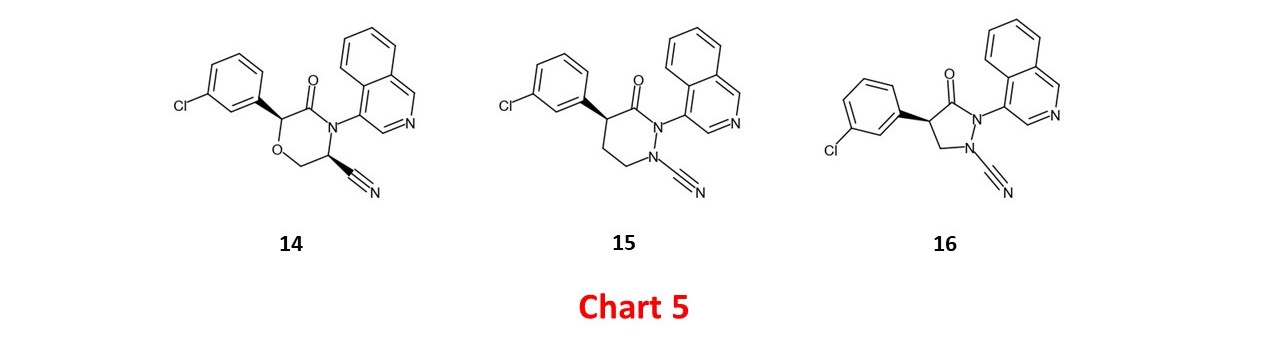
I’ll kick the post off with 14 (Chart 5) which replaces a methylene in the lactam ring of 10 (Chart 4 in previous post) with oxygen. This structural transformation results in 0.8 log unit reduction in lipophilicity (at least according to the algorithm used for the Covid Moonshot) and might also simplify the synthesis.
Designs 15 and 16 (also in Chart 5) link the nitrile warhead from nitrogen rather than carbon and this structural transformation eliminates a chiral centre in each of 10 and 11 (Chart 4 in previous post) and may be beneficial for affinity (see discussion around 8 and 9 in Chart 3 of the previous post). In substituted hydrazine derivatives, the nitrogen lone pairs (or the π-systems which the nitrogens are in) tend to avoid each other and so I’d expect nitrile warheads of 15 and 16 to adopt axial orientations. I’d anticipate that the nitrile warhead will be directed toward the catalytic cysteine for 15 but away from the catalytic cysteine for 16 and I favor the former for this for this reason. It's also worth mentioning that even if the nitrile is directed away from the catalytic cysteine it may occupy the oxyanion hole.

I’ll finish with couple of designs based on aromatic sulfur that are shown in Chart 6. Design 17 was originally submitted by Vladas Oleinikovas although I’ll also link my resubmission of this design because the notes include a detailed discussion of a design rationale along with a proposed binding mode. My view is that the catalytic cysteine could get within striking distance of the ring sulfur (which can function as a chalcogen-bond donor and potentially even an electrophile). Although 2,1-benzothiazole is not obviously electrophilic, it’s worth noting that acetylene linked by saturated carbon can replace the nitrile as an electrophilic warhead (this isosteric replacement leads to irreversible inhibition as discussed in this article). I’ve also included 18 which replaces 2,1-benzothiazole with (what I’d assume is) a more electrophilic heterocycle. I would anticipate that any covalent inhibition by these compounds will be irreversible.


Thursday, 19 January 2023

Some approaches to design of covalent inhibitors of SARS-CoV-2 main protease

<< previous | next >>

I last posted on Covid-19 early in 2021 and quite a lot has happened since then. Specifically, a number of vaccines are now available (I received my first dose of AstraZeneca CoviShield in May 2021 while still stranded in Trinidad) and paxlovid has been approved for use as a Covid-19 treatment (Derek describes his experiences taking paxlovid in this post).  The active ingredient of paxlovid is the SARS-CoV-2 main protease inhibitor nirmatrelvir and the ritonavir with which it is dosed serves only to reduce clearance of nirmatrelvir by inhibiting metabolic enzymes. In the current post, I’ll be looking at covalent inhibition of SARS-CoV-2 main protease with a specific focus on reversibility and here are some notes that I whipped up as a contribution to the Covid Moonshot.

Nirmatrelvir (1) is shown in Chart 1 along with SARS-CoV-2 main protease inhibitors from the Covid Moonshot (2), a group of (mainly) Sweden-based academic researchers (3) and Yale University (4).  Nirmatrelvir incorporates a nitrile group that forms a covalent bond with the catalytic cysteine and the other inhibitors bind non-covalently to the target. The first example of a nitrile-based cysteine protease inhibitor that I’m aware of was published over half a century ago and the nitrile warhead has since proved popular with designers of cysteine protease inhibitors (it has a small steric footprint and is not generally associated with metabolic lability or chemical instability). Furthermore, covalent bond formation between the thiol of a catalytic cysteine and the carbon of the nitrile warhead is typically reversible. Here’s a recent review on the nitrile group in covalent inhibitor design and this comparative study of electrophilic warheads may also be of interest.

At this point, we should be thinking about the directions in which design of SARS-CoV-2 main protease inhibitors needs to go. Two directions I see as potentially productive are dose reduction (a course of paxlovid treatment consists of two 150 mg nirmatrelvir tablets and one 100 mg ritonavir tablet taken twice daily for five days) and countering resistance (here’s a relevant article).

Two tactics for achieving a lower therapeutic dose are to increase affinity and reduce clearance. Dose prediction is not as easy as you might think because the predictions are typically very sensitive to input parameters. For example, a two-fold difference in IC50 would often be regarded as within normal assay variation by medicinal chemists but development scientists and clinicians would view doses of 300 mg and 600 mg very differently. 

Excessive clearance is a problem from the perspective of achieving adequate exposure and I'd also anticipate greater variability in exposure between patients when clearance is high. Clearance is clearly an issue for nirmatrelvir because it needs be co-dosed with ritonavir (to inhibit metabolic enzymes) and this has implications for patients taking other medications. Nirmatrelvir lacks aromatic rings and deuteration is an obvious tactic to reduce metabolic lability (although cost of goods is likely to be more of an issue than for a cancer medicine that you'll need to take out a second mortgage for). I would anticipate that bicyclo[1.1.1]pentanyl will be less prone to metabolism than t-butyl (CH bonds tend to be stronger in strained rings and for bridgehead CHs) and the binding mode suggests that this replacement could be accommodated. 

Details of resistance to nirmatrelvir (P2022 | Z2022) are starting to emerge and this information should be certainly be used in design and to assess other structural series. Nevertheless, if you’re genuinely concerned about potential for resistance then you really can’t afford to ignore conserved structural features in the target such as the catalytic residues (cysteine and histidine) and the oxyanion hole. I would also anticipate that the risk of resistance will increase with the spatial extent of the inhibitor.

This post is about covalent inhibitors. Although I’m pleasantly surprised by the potencies achieved for non-covalent SARS-Cov-2 Main Protease inhibitors, I consider making a virtue of non-covalent inhibition to be a serious error. Binding of covalent inhibitors to their targets can be reversible  or irreversible and, in the context of design, reversible covalent inhibitors have a lot more in common with non-covalent inhibitors than with irreversible covalent inhibitors (for example, you can't generally use mass spectroscopy to screen covalent fragments that bind reversibly). In the context of drug design, covalent bonds have much more stringent geometric requirements than non-covalent interactions such as hydrogen bonds.   

I generally favor reversible binding when targeting catalytic cysteines as discussed in these notes and this article. It is typically less difficult to design reversible covalent inhibitors to target a catalytic cysteine than it is to design irreversible covalent inhibitors because you can use crystal structures of protein-ligand complexes just as you would for non-covalent inhibitors. In contrast, the crystal of a protein-ligand complex (the reaction ‘product’) is not especially relevant in design of irreversible inhibitors because target engagement is under kinetic rather than thermodynamic control and the more relevant transition state models must therefore be generated computationally. Furthermore, assays for irreversible inhibitors are more complex, and assessment of functional selectivity and safety is more difficult than for reversible inhibitors. All that said, however, I’m certainly not of the view that irreversible inhibitors are inherently inferior to reversible inhibitors for targeting catalytic cysteines. This is also a good point to mention an article which shows how isosteric replacement (with an alkyne) of the nitrile warhead of the reversible cathepsin K inhibitor odanacatib results in an irreversible inhibitor (the article is particularly relevant if you’re interested in chemical probes for cysteine proteases).

I contributed some designs for reversible covalent inhibitors to the Covid Moonshot and it may be helpful to discuss some of them. Each design was intended to link the nitrile warhead to the ‘3-aminopyridine-like’ scaffold used in the Covid Moonshot which means that the designs all use a heteroaromatic P1 group (typically isoquinoline linked at C4) rather than the chiral P1 group (pyrrolidinone linked at C3) used for nirmatrelvir and a number of other SARS-CoV-2 main protease inhibitors. The ‘3-aminopyridine-like’ scaffold lacks essential hydrogen bond donors (elimination of hydrogen bond donors is suggested as a tactic for increasing aqueous solubility in this article). One of the cool things about the way the Covid Moonshot was set up is that I can link designs as they were originally submitted (often with a detailed rationale and proposed binding mode).

The most direct way to link a nitrile to the ‘3-aminopyridine-like’ scaffold is with methylene (5, Chart 2) but there is a problem with this approach because substituting anilides (and their aza-analogs) on nitrogen with sp3 carbon inverts the cis/trans geometrical preference of the anilides (I discussed the design implications of this in these notes).  This implies that binding of 5 to the target is expected to incur a conformational energy penalty and it is significant that N-methylation of 6 results in a large reduction in potency. Although 5 was inactive in the enzyme inhibition assay, I think that it would still be worth seeing if covalent bond formation can be observed by crystallography for this compound.

However, you won’t invert cis/trans geometrical preference if you substitute an anilide nitrogen with nitrogen rather than sp3 carbon (Chart 3). This was the basis for submitting 8, which is related to azapeptide nitriles, as a design.  Azapeptide nitriles [L2008 | Y2012 | L2019 | B2022] are typically more potent than the corresponding peptide nitriles and, to be honest, this remains something of a mystery to me (one possibility is that the imine nitrogen of the azapeptide nitrile adduct is more basic than that of the corresponding peptide nitrile adduct and is predominantly protonated under assay conditions). I see cyanohydrazines and cyanamides as functional groups that would be worth representing in fragment libraries if you want to target catalytic cysteine residues and I’ll point you toward a relevant crystal structure. The acyclic hydrazine and cyanamide substructures in 8 trigger structural alerts although there are approved drugs that incorporate acyclic hydrazine (atazanavir | bumadizone | gliclazidegoserelin | isocarboxazid | isoniazid) and N-cyano (cimetidine) substructures. The basis for these structural alerts is obscure and it’s worth noting that 8 is incorrectly flagged as an enamine and having a nitrogen-oxygen single bond. As a cautionary tale on structural alerts, I’ll refer you to this comment in which I read the riot act (i.e., the JMC guidelines for authors) to a number of ACS journal EiCs Nevertheless, I’d still worry about the presence of an acyclic hydrazine substructure although these concerns would be eased if each nitrogen atom was bonded to an electron-withdrawing group, as is the case for 8, and all NHs were capped (see 9).


An alternative tactic to counter inversion of the cis/trans geometrical preference is to lock the conformation with a ring and designs 10 and 11 (Chart 4) can be seen as 'hybrids' of 5 with 12 and 13 respectively (in fragment-based design, hybridization is usually referred to as fragment merging). The effect of the conformational lock can be clearly seen since 12 and 13 are essentially equipotent with 6 (the primary reason for proposing 12 and 13 as designs was actually to present the nitrile warhead to the catalytic cysteine). A substituent on carbon next to a lactam nitrogen tends to adopt an axial orientation and I’d anticipate that 10 will be less prone to epimerization than 11. Although I'm unaware of nitriles being deployed on cyclic amine substructures for cysteine protease inhibition, the structures of the DPP-4 inhibitors saxagliptin and vildagliptin are relevant.


This is a good point at which to wrap up. If cysteine protease inhibition is a key component of pandemic preparedness strategy then you really do need to be thinking about covalent inhibition.  I'll be looking at some more design themes for covalent inhibitors of SARS-CoV-2 in the next Covid post.