Showing posts with label machine learning. Show all posts

Monday, 22 June 2026

The OpenBind initiative

I’ll open the post on the OpenBind initiative with photos from my visit last year to Korea which was timed to coincide with the cherry blossoms (this meant that the customary April Fools post was from Seoul). Things did not start well on the day that I took these photos (having lined up the first shot for the day it became abundantly clear that the camera’s battery was still being charged at the hotel) and I wondered whether Great Leader’s grandson might have labelled me as a dotard. Fortunately, Seoul’s Metro is excellent and I was still able to get some photos at Huiujeong-ro Cherry Blossom Road and Yangjaecheon Stream.


In this post I’ll be taking a look at the OpenBind initiative and here's a summary of the concept. I certainly see great value in having large quantities of this type of data (affinity measurements with X-ray crystal structures for the corresponding protein-ligand complexes) to the drug discovery and chemical biology communities. The grating-coupled interferometry (GCI) protocol used for affinity measurement enables association and dissociation to be observed in real time and presumably it is also possible to characterize stoichiometry using this technique. I would expect he GCI protocol to enable weaker binding affinities to be reliably quantified (likely to increase the dynamic range of the assay) as well as allowing measurement of binding affinity of glycoproteins for ligands. Given the focus on enabling affinity prediction, there is no reason for excluding anti-targets or non-human proteins.  

Generation of data for training machine learning (ML) models, which are renowned for their voracious appetite for data, appears to be the principal aim of the initiative. However, the availability of large quantities of such data will also enable more extensive evaluation of physics-based methods for calculating binding affinity and can potentially inform hypothesis-driven design by identifying bioisosteric relationships between elements of substructure. One point worth making is that having affinity measurements linked to protein-ligand structures for structurally-related compounds of varying molecular complexity (see HLH2001) enables frustration of molecular interactions to be studied (this is particularly relevant to fragment-based design) and I discussed in HBD3 how frustration of hydration might be exploited in design. Given the importance of aqueous solvation in biomolecular recognition it may be beneficial to measure some alkane/water partition coefficient values and I'll point you to a post on this topic in case it's of interest. As discussed in KMP2013 and B2017 polarity parameters can be derived from alkane/water partition coefficient measurements for functional groups. 

I've suggested that there are three objectives to drug design and the OpenBind initiative addresses the first of these which is to maximize on-target bioactivity. It's worth noting that proteins are not the only drug target class of interest (see CD2022) while bioactivity for ‘new modalities’ such as targeted protein degradation (see CC2026) and irreversible covalent bond formation between targets and ligands cannot be quantified in terms of affinity alone. My view is that OpenBind would be more accurately described as an initiative for ligand discovery than for drug discovery given its focus on enabling methods for affinity prediction.  Modern ML models for affinity prediction are effectively quantitative structure-activity relationship (QSAR) models and I would question whether the use of the AI label is justified in either case. All that said, I would expect OpenBind to catalyse significant progress in the affinity prediction field which hopefully will translate to tangible benefits for drug discovery.

It’s perhaps appropriate to take a general look at QSAR approaches given that the main focus of OpenBind appears to be generation of data for training what could be referred to as 'QSAR-like' ML models. In my view, QSAR modelling never made much of a splash in real world drug discovery and claims that particular models have made significant impact on drug discovery projects are generally not verifiable. A difficulty faced by QSAR practitioners was that projects had delivered or been put out of their misery by the time there was sufficient data for building predictively useful models. Medicinal chemists typically perform their optimizations within specific structural series and this means that structure-activity relationships (SARs) tend to be local in nature (I’m not aware of any studies in which a QSAR model built using only data from one structural series was convincingly shown to be usefully predictive of bioactivity for compounds in a different structural series). For users of ML bioactivity models it is important to know whether chemical structures for which predictions are being made lie within the applicability domains of the models. Put another way, medicinal chemists who use ML models are generally more interested in how well the models predict for the structural series that they're working on and less interested in how well the models have fit the training data (anybody who has received financial advice will be familiar with the "past performance is not indicative of future results" disclaimer). The selection criteria for inclusion of targets and ligands by the OpenBind initiative are not currently clear and I'm guessing that large scale structural determination might prove challenging for membrane proteins.  

The availability of affinity measurements that are linked to X-ray crystal structures for the corresponding protein-ligand complexes enables affinity to be modelled in terms of the molecular interactions between proteins and their ligands. This is the approach used to create the scoring functions used in virtual screening and it provides a means to address the local nature of SARs. While this might seem to be an obvious way to model affinity data it's important to be aware that the contribution to affinity of an individual contact, such as a hydrogen bond, between the protein and ligand is not an experimental observable (see NoLE). Put another way, there is no unique way of decomposing a value of ΔG° (standard Gibbs free energy of binding) into a sum of terms based on individual noncovalent contacts between the protein and ligand. One reason reason for this is that association of proteins with their ligands occurs in aqueous media and this point has been clearly articulated in the S2012 study:

Molecular binding in an aqueous solvent can be usefully viewed not as an association reaction, in which only new intermolecular interactions are introduced between receptor and ligand, but rather as an exchange reaction in which some receptor–solvent and ligand–solvent interactions present in the unbound state are lost to accommodate the gain of receptor–ligand interactions in the bound complex.

However, there’s another reason why there’s no unique way to decompose binding free energy into a sum of terms based on individual noncovalent contacts and here’s a well-known equation written a bit differently to how you normally see it written:


This shows that the value of ΔG° varies with the concentration, C°, that defines the standard state. By convention C° is set to 1 M although this is arbitrary and has no physical basis (see G1997) and this means that the binding free energy values encountered by drug discovery scientists are always negative (consider the feasibility of measuring a Kd value of greater than 1 M). Writing ΔG° as a sum of terms based on individual non-covalent contacts is challenging because each term needs to depend on C° while the sum of terms needs to reproduce the dependence of ΔG° on C°. This is discussed in NoLE and the problems can be seen more easily if you think about how you might write Kd as a product of terms based on individual non-covalent contacts. The dependence of ΔG° on C° has implications for interpretability of ML models for binding affinity.

My understanding is that scoring functions (see GPD2018 | WBS2017 | A2015 | C2012 | S2012 | F2004SR2001 | GHK2000 | MM1999 | E1997 | MSK1992)  used in virtual screening are generally not predictive of affinity to the extent that they can be routinely used in lead optimization. Perhaps it will be different for Boltz-2 (described in the P2025 preprint) although questions have been raised in BSR2026 as to whether Boltz-2 "truly relies on the physics of intermolecular interactions" and the term “absolute FEP” does ring some alarm bells for me. Various explanations have been offered for the typically underwhelming performance of scoring functions for affinity prediction including the usual suspects (protein flexibility, solvation and entropy). However, a much simpler explanation might be that scoring functions are trained to predict the difference in free energy between two states by only using the structure corresponding to one of the states.

I remain sceptical that it will prove feasible to build genuinely universal models for prediction of binding affinity from structures of protein-ligand complexes although I'll be very happy if my scepticism is shown to be unfounded. Describing energetics of target-ligand interactions in a general manner to enable ML modelling of affinity will be challenging because of the necessity to encode factors such as interaction potential, geometric dependence and solvent exposure (bear in mind that physics-based methods for prediction of affinity are already available and I'll direct readers to the Open Free Energy and open forcefield initiatives). While modelling affinity in terms of molecular interactions circumvents the need for training data to sample every conceivable combination of structural series with target, the need to meaningfully define applicability domains does not disappear.  My view is that when affinity datasets for different targets are combined for ML modelling, data should be split at the target level for cross-validation. This would entail splitting data so that each test set consists of only (and all) the data for a single target. I have argued in a previous post that the complexity (for example, number of parameters used to fit the training data) of models should be properly accounted for when comparing performance for ML models. 

Datasets generated by OpenBind are likely to also prove valuable for testing and development of physics-based approaches to affinity prediction such as use of simulation to calculate ‘absolute’ (ΔG°) and ‘relative’ (ΔΔG) free energy of binding.  Physics-based free energy calculations are typically more computationally demanding for ΔG° than for ΔΔG (a view expressed in B2009 is that it's generally easier to predict differences in property values for pairs of structurally-related compounds than it is to predict property values from chemical structures of compounds). Methods for calculating ΔΔG (here’s a helpful review) are especially relevant to drug design because medicinal chemists typically work within structural series, defining SARs in terms of ratios of affinity (or potency) for pairs of structurally-related compounds. Put another way, ΔΔG calculations enable project team scientists to exploit existing project data to predict affinity for potential synthetic candidates and I would argue that ML modellers really do need to be thinking more about prediction of differences in affinity (and other pharmaceutically relevant properties) between structurally related compounds. As an aside, free energy perturbation (FEP) was a major source of inspiration when I started to use the Leatherface (don't ask  😁😁😁) chemical structure editing software to do matched molecular pair analysis (MMPA) in the late 1990s, even though physics-based ΔΔG calculations were still largely seen as academic curiosities at that time.

While I’m certainly enthusiastic about physics-based methods such as FEP for calculating ΔΔG it’s not clear how generally these can handle significant modifications to the core of a structure (this is the scaffold-hopping scenario) and I would anticipate difficulties when the main effect of the structural perturbation is to alter conformational preference (as is the case for N-methylation of the secondary amide that is conserved in a number of SARS-CoV-2 main protease inhibitors). That said, the data generation capability of the OpenBind initiative should enable perceived weaknesses in FEP methodology to be addressed. I'll highlight a couple of general ways to use the data sets that OpenBind will generate might be used to validate methods for predicting relative affinity. First, you can use the relative affinity values that correspond to specific structural transformations such as chloro substitution (a good way to study activity cliffs and focusing on specific structural transformations counters criticism that predictive models are just capturing lipophilicity or molecular size), chloro to bromo (a good way to see if you're modelling halogen bonding effectively), and aromatic nitrogen to CH (in design it is useful to determine where polarity can be introduced with minimal loss of affinity). Second, you can use relative affinity measurements to assess how well models predict non-additivity in SARs (non-additivity can be also be considered in th activity cliff framework). I should point out that neither of these suggestions is novel (see L2012 and C2016) and activity to ML modellers are already looking at activity cliffs (see vT2022).     

This is a good point at which to wrap up and I'll be taking a look at the OpenADMET initiative in the next post.

Wednesday, 27 September 2023

Five days in Vermont

A couple of months ago I enjoyed a visit to the US (my first for eight years) on which I caught up with old friends before and after a few days in Vermont (where a trip to the golf course can rapidly become a National Geographic Moment). One highlight of the trip was randomly meeting my friend and fellow blogger Ash Jogalekar for the first time in real life (we’ve actually known each other for about fifteen years) on the Boston T Red Line.  Following a couple of nights in green and leafy Belmont, I headed for the Flatlands with an old friend from my days in Minnesota for a Larry Miller group reunion outside Chicago before delivering a short harangue on polarity at Ripon College in Wisconsin. After the harangues, we enjoyed a number of most excellent Spotted Cattle (Only in Wisconsin) in Ripon. I discovered later that one of my Instagram friends is originally from nearby Green Lake and had taken classes at Ripon College while in high school. It is indeed a small world.

The five days spent discussing computer-aided drug design (CADD) in Vermont are what I’ll be covering in this post and I think it’s worth saying something about what drugs need to do in order to function safely.  First, drugs need to have significant effects on therapeutic targets without having significant effects on anti-targets such as hERG or CYPs and, given the interest in new modalities, I’ll be say “effects” rather than “affinity”, although Paul Ehrlich would have reminded us that drugs need to bind in order to exert effects. Second, drugs need to get to their targets at sufficiently high concentrations for their effects to be therapeutically significant (drug discovery scientists use the term ‘exposure’ when discussing drug concentration). Although it is sometimes believed that successful drugs simply reduce the numbers of patients suffering from symptoms it has been known from the days of Paracelsus that it is actually the dose that differentiates a drug from a poison.

Drug design is often said to be multi-objective in nature although the objectives are perhaps not as numerous as many believe (this point is discussed in the introduction section of NoLE, an article that I'd recommend to insomniacs everywhere). The first objective of drug design can be stated in terms of minimization of the concentration at which a therapeutically useful effect on the target is observed (this is typically the easiest objective to define since drug design is typically directed at specific targets). The second objective of drug design can be stated in analogous terms as maximization of the concentration at which toxic effects on the anti-targets are observed (this is a more difficult objective to define because we generally know less about the anti-targets than about the targets). The third objective of drug design is to achieve controllability of exposure (this is typically the most difficult objective to define because drug concentration is a dose-dependent, spaciotemporal quantity and intracellular concentration cannot generally be measured for drugs in vivo). Drug discovery scientists, especially those with backgrounds in computational chemistry and cheminformatics, don’t always appreciate the importance of controlling exposure and the uncertainty in intracellular concentration always makes for a good stock question for speakers and panels of experts.

I posted previously on  artificial intelligence (AI) in drug design and I think it’s worth highlighting a couple of common misconceptions. The first misconception is that we just need to collect enough data and the drugs will magically condense out of the data cloud that has been generated (this belief appears to have a number of adherents in Silicon Valley).  The second misconception is that drug design is merely an exercise in prediction when it should really be seen in a Design of Experiments framework. It’s also worth noting that genuinely categorical data are rare in drug design and my view is that many (most?) "global" machine learning (ML) models are actually ensembles of local models (this heretical view was expressed in a 2009 article and we were making the point that what appears to be an interpolation may actually be an extrapolation). Increasingly, ML is becoming seen as a panacea and it’s worth asking why quantitative structure activity relationship (QSAR) approaches never really made much of a splash in drug discovery.

I enjoyed catching up with old friends [ D | K | S | R/J | P/M ] as well as making some new ones [ G | B/R | L ]. However, I was disappointed that my beloved Onkel Hugo was not in attendance (I continue to be inspired by Onkel’s laser-like focus on the hydrogen bonding of the ester) and I hope that Onkel has finally forgiven me for asking (in 2008) if Austria was in Bavaria. There were many young people at the gathering in Vermont and their enthusiasm made me greatly optimistic for the future of CADD (I’m getting to the age at which it’s a relief not to be greeted with: "How nice to see you, I thought you were dead!"). Lots of energy at the posters (I learned from one that Voronoi was Ukrainian) although, if we’d been in Moscow, I’d have declined the refreshments and asked for a room on the ground floor (left photo below).  Nevertheless, the bed that folded into the wall (centre and right photos below) provided plenty of potential for hotel room misadventure without the ‘helping hands’ of NKVD personnel.

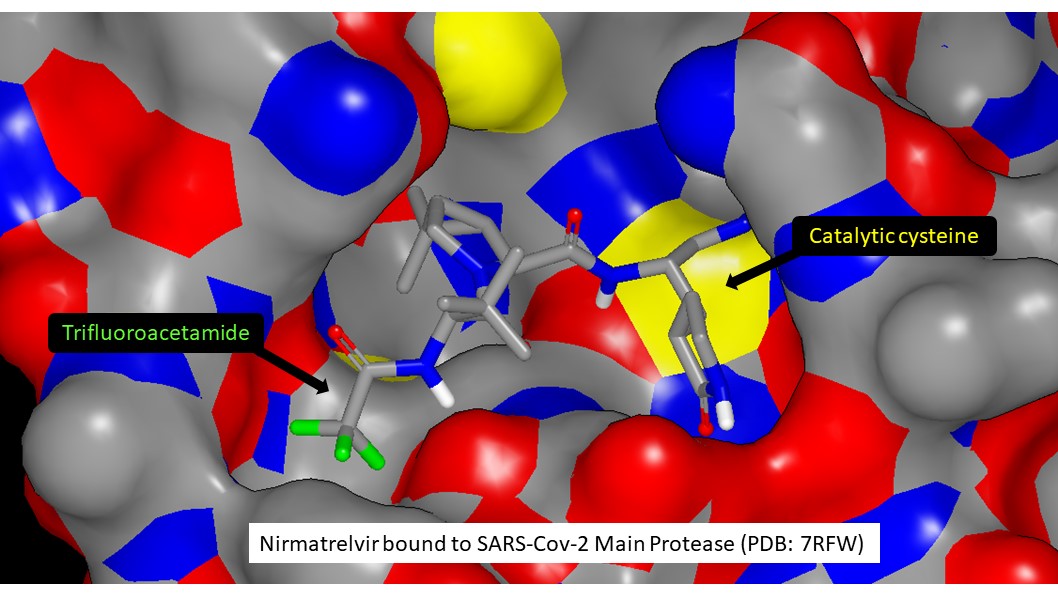
It'd been four years since CADD had been discussed at this level in Vermont so it was no surprise to see COVID-19 on the agenda. The COVID-19 pandemic led to some very interesting developments including the Covid Moonshot (a very different way of doing drug discovery and one I was happy to contribute to during my 19 month sojourn in Trinidad) and, more tangibly, Nirmatrelvir (an antiviral medicine that has been used to treat COVID-19 infections since early 2022). Looking at the molecular structure of Nirmatrelvir you might have mistaken trifluoroacetyl for a protecting group but it’s actually a important feature (it appears to be beneficial from the permeability perspective). My view is that the alkane/water logP (alkane is a better model than octanol for the hydrocarbon core of a lipid bilayer) for a trifluoroacetamide is likely to be a couple of log units greater than for the corresponding acetamide.


I’ll take you through how the alkane/water logP difference between a trifluoroacetamide and corresponding acetamide can be estimated in some detail because I think this has some relevance to using AI in drug discovery (I tend to approach pKa prediction in an analogous manner). Rather than trying to build an ML model for making the prediction, I’ve simply made connections between measurements for three different physicochemical properties (alkane/water logP, hydrogen bond basicity and hydrogen bond acidity) which is something that could easily be accommodated within an AI framework. I should stress that this approach can only be used because it is a difference in alkane/water logP (as opposed to absolute values) that is being predicted and these physicochemical properties can plausibly be linked to substructures.

Let’s take a look at the triptych below which I admit that is not quite up to the standards of Hieronymus Bosch (although I hope that you find it to be a little less disturbing). The first panel shows values of polarity (q) for some hydrogen bond acceptors and donors (you can find these in Tables 2 and 3 in K2022) that have been derived from alkane/water logP measurements. You could, for example, use these polarity values to predict that reducing the polarity of an amide carbonyl oxygen to the extent that it looks like a ketone will lead to a 2.2 log unit increase in alkane/water logP.  The second panel shows measured hydrogen bond basicity values for three hydrogen bond acceptors (you can find these in this freely available dataset) and the values indicate that a trifluoroacetamide is an even weaker hydrogen bond acceptor than a ketone. Assuming a linear relationship between polarity and hydrogen bond basicity, we can estimate that the trifluoroacetamide carbonyl oxygen is 2.4 log units less polar than the corresponding acetamide. The final panel shows measured hydrogen bond acidity values (you can find these in Table 1 of K2022) that suggest that an imide NH (q = 1.3; 0.5 log units more polar than typical amide NH) will be slightly more polar than the trifluoroacetamide NH of Nirmatrelvir. So to estimate he difference in alkane/water logP values you just need to subtract the additional polarity of trifluoroacetamide NH (0.5 log units) from the lower polarity of the trifluoroacetamide carbonyl oxygen (2.4) to get 1.9 log units.


Chemical space is a recurring theme in drug design and its vastness, which defies human comprehension, has inspired much navel-gazing over the years (it’s actually tangible chemical space that’s relevant to drug design). In drug discovery we need to be able to navigate chemical space (ideally without having to ingest huge quantities of Spice) and, given that Ukrainian chemists have revolutionized the world's idea of tangible chemical space (and have also made it a whole lot larger), it is most appropriate to have a Ukrainian guide who is most ably assisted by a trusty Transylvanian sidekick. I see benefits from considering molecular complexity more explicitly when mapping chemical space. 
   
AI (as its evangelists keep telling us) is quite simply awesome at generating novel molecular structures although, as noted in a previous post, there’s a little bit more to drug design than simply generating novel molecular structures. Once you’ve generated a novel molecular structure you need to decide whether or not to synthesize the compound and, in AI-based drug design, molecular structures are often assessed using ML models for biological activity as well as absorption, distribution, metabolism and excretion (ADME) behaviour. It’s well-known that you need a lot of data for training these ML models but you also need to check that the compounds for which you’re making predictions lie within the chemical space occupied by the training set (one way to do this is to ensure that close structural analogs of these compounds exist in the training set) because you can’t be sure that the big data necessarily cover the regions of chemical space of interest to drug designers using the models. A panel discusses the pressing requirement for more data although ML modellers do need to be aware that there’s a huge difference between assembling data sets for benchmarking and covering chemical space at sufficiently high resolution to enable accurate prediction for arbitrary compounds.  

There are other ways to think about chemical space. For example, differences in biological activity and ADME-related properties can also be seen in terms of structural relationships between compounds. These structural relationships can be defined in terms of molecular similarity (Tanimoto coefficient for the molecular fingerprints of X and Y is 0.9) or substructure (X is the 3-chloro analog of Y). Many medicinal chemists think about structure-activity relationships (SARs) and structure-property relationships (SPRs) in terms of matched molecular pairs (MMPs: pairs of molecular structures that are linked by specific substructural relationships) and free energy perturbation (FEP) can also be seen in this framework. Strong nonadditivity and activity cliffs (large differences in activity observed for close structural analogs) are of considerable interest as SAR features in their own right and because prediction is so challenging (and therefore very useful for testing ML and physics-based models for biological activity). One reason that drug designers need to be aware of activity cliffs and nonadditivity in their project data is that these SAR features can potentially be exploited for selectivity.
        
Cheminformatic approaches can also help you to decide how to synthesize the compounds that you (or your AI Overlords) have designed and automated synthetic route planning is a prerequisite for doing drug discovery in ‘self-driving’ laboratories. The key to success in cheminformatics is getting your data properly organized before starting analysis and the Open Reaction Database (ORD), an open-access schema and infrastructure for structuring and sharing organic reaction data, facilitates training of models. One area that I find very exciting is the use of high-throughput experimentation in the search for new synthetic reactions which can led to better coverage of unexplored chemical space. It’s well known in industry that the process chemists typically synthesize compounds by routes that differ from those used by the medicinal chemists and data-driven multi-objective optimization of catalysts can lead to more efficient manufacturing processes (a higher conversion to the desired product also makes for a cleaner crude product). 

It’s now time to wrap up what’s been a long post. Some of what is referred to as AI appears to already be useful in drug discovery (especially in the early stages) although non-AI computational inputs will continue to be significant for the foreseeable future. I see a need for cheminformatic thinking in drug discovery to shift from big data (global ML models) to focused data (generate project specific data efficiently for building local ML models) and also see advantages in using atom-based descriptors that are clearly linked to molecular interactions. One issue for data-driven approaches to prediction of biological activity such as ML and QSAR modelling is that the need for predictive capability is greatest when there's not much relevant data and this is a scenario under which physics-based approaches have an advantage. In my view, validation of ML models is not a solved problem since clustering in chemical space can cause validation procedures to make optimistic assessments of model quality. I continue to have significant concerns about how relationships (which are not necessarily linear) between descriptors are handled in ML modelling and remain generally skeptical of claims for interpretability of ML models (as noted in NoLE, the contribution of a protein–ligand contact to affinity is not, in general, an experimental observable).

Many thanks for staying with me to the end and hope to see many of you at EuroQSAR in Barcelona next year. I'll leave you with a memory from the early days of chemical space navigation.


Wednesday, 29 May 2019

Transforming computational drug discovery (but maybe not)


"A theory has only the alternative of being right or wrong. A model has a third possibility: it may be right, but irrelevant."
Manfred Eigen (1927 - 2019)

I'll start this blog post with some unsolicited advice to those who seek to transform drug discovery. First, try to understand what a drug needs to do (as opposed to what compound quality 'experts' tell us a drug molecule should look like). Second, try to understand the problems that drug discovery scientists face and the constraints under which they have to solve them. Third, remember that many others have walked this path before and difficulties that you face in gaining acceptance for your ideas may be more a consequence of extravagant claims made previously by others than of a fundamentally Luddite nature of those whom you seek to influence. As has become a habit, I'll include some photos to break the text up a bit and the ones in this post are from Armenia.

Mount Ararat taken from the Cascade in Yerevan. I stayed at the excellent Cascade Hotel which is a two minute walk from the bottom of the Cascade.

Here are a couple of slides from my recent talk at Maynooth University that may be helpful to machine learning evangelists, AI visionaries and computational chemists who may lack familiarity with drug design. The introductions to articles on ligand efficiency and correlation inflation might also be relevant.

Defining controllability of exposure (drug concentration) as a design objective is extremely difficult while unbound intracellular drug concentration is not generally measurable in vivo.


Computational chemists and machine learning evangelists commonly make (at least) one of two mistakes when seeking to make impact on drug design. First, they see design purely as an exercise in prediction. Second, they are unaware of the importance of exposure as the driver of drug action. I believe that we'll need to change (at least) one of these characteristics of drug design if we are to achieve genuine transformation.

In this post, I'm going to take a look at an article in ACS Medchem Letters entitled 'Transforming Computational Drug Discovery with Machine Learning and AI'. The article opens with a Pablo Picasso quote although I'd argue that the observation made by Manfred Eigen at the beginning of the blog post would be way more appropriate. The World Economic Forum (WEF) is quoted as referring to "to the combination of big data and AI as both the fourth paradigm of science and the fourth industrial revolution". The WEF reference reminded me of an article (published in the same journal and reviewed in this post) that invoked "views obtained from senior medicinal chemistry leaders". However, I shouldn't knock the WEF reference too much since we observed in the correlation inflation article that "lipophilicity is to medicinal chemists what interest rates are to central bankers".

The Temple of Garni is the only Pagan temple in Armenia and is sited next to a deep gorge (about 20 metres behind me). I took a keen interest in the potential photo opportunities presented by two Russian ladies who had climbed the safety barrier and were enthusiastically shooting selfies...

Much of the focus of the article is on the ANI-1x potential (and related potentials), developed by the authors for calculation of molecular energies. These potentials were derived by using a deep neural network to fit calculated (DFT) molecular energies to calculated molecular geometry descriptors. This certainly looks like an interesting and innovative approach to calculating energies of molecular structures. It's also worth mentioning the Open Force Field Initiative since they too are doing some cool stuff. I'll certainly be watching to see how it all turns out.

One key question concerns accuracy of DFT energies. The authors talk about a "zoo" of force fields but I'm guessing the diversity of DFT protocols used by computational chemists may be even greater than the diversity of force fields (here's a useful review). Viewing the DFT field as an outsider, I don't see a clear consensus as to the most appropriate DFT protocol for calculating molecular energy and the lack of consensus appears to be even more marked when considering interactions between molecules. It's also worth remembering that the DFT methods are themselves parameterized.  

Potentials such as those described by the authors are examples of what drug discovery scientists would call a quantitative structure-property relationship (QSPR). When assessing whether or not a model constitutes AI in the context of drug discovery, I would suggest consideration of the nature of the model rather than the nature of the algorithm used to build the model. The fitting of DFT energies to molecular descriptors that the authors describe is considerably more sophisticated than would be the case for a traditional QSPR. However, there are a number of things that you need to keep in mind when fitting measured or calculated properties to descriptors regardless of the sophistication of the fitting procedure. This post on QSAR as well as the recent exchange ( 1 | 2 | 3 ) between Pat Walters and me may be informative. First, over-fitting is always a concern and validation procedures may make an optimistic assessment of model quality when the space spanned by descriptors is unevenly covered. Second, it is difficult to build stable and transferable models if there are relationships between descriptors (the traditional way to address this problem is to first perform principal component analysis which assumes that the relationships between descriptors is linear). Third, it is necessary to account for numbers of adjustable parameters in models in an appropriate manner if claiming that one model has outperformed another.


Armenia appeared to be awash with cherry blossoms when I visited in April. This photo was taken at Tatev Monastery which can be accessed by cable car.

The authors have described what looks to be a promising approach to calculation of molecular energies. Is it AI in the context of drug discovery? I would say, "no, or at least no more so than the QSPR and QSAR models that have been around for decades". Will it transform computational drug discovery? I would say, "probably not". Now I realize that you're thinking that I'm a complete Luddite (especially given my blinkered skepticism of the drug design metrics introduced by Pharma's Finest Minds) but I can legitimately claim to have exploited knowledge of ligand conformational energy in a real discovery project. I say "probably not" simply because drug designers have been able to calculate molecular energy for many years although I concede that the SOSOF (same old shit only faster) label would be unfair. That said, I would expect faster, more accurate and more widely applicable methods to calculate molecular energy to prove very useful in computational drug discovery. However, utility is a necessary, but not sufficient, condition for transformation.


Geghard Monastery was carved from the rock

So I'll finish with some advice for those who manage (or, if you prefer, lead) drug discovery.  Suppose that you've got some folk trying to sell you an AI-based system for drug design. Start by getting them to articulate their understanding of the problems that you face. If they don't understand your problems then why should you believe their solutions? Look them in the eye when you say "unbound intracellular concentration" to see if you can detect signs of glazing over. In particular, be wary of crude scare tactics such as the suggestion that those medicinal chemists that don't use AI will lose their jobs to medicinal chemists who do use AI. If the terrors of being left behind by the Fourth Industrial Revolution are invoked then consider deploying the conference room furniture that you bought on eBay from Ernst Stavro Blofeld Associates.

Selfie with MiG-21 (apparently Artem's favorite) at the Mikoyan Brothers Museum in Sanahin where the brothers grew up. Anastas was even more famous than his brother and played a key role in defusing the Cuban Missile Crisis.

Monday, 21 January 2019

Response to Pat Walters on ML in drug discovery

Thanks again for your response, Pat, and I’ll try to both clarify my previous comments and respond to the challenges that you’ve presented (my comments are in red italics).

In defining ML as “a relatively well-defined subfield of AI” I was simply attempting to establish the scope of the discussion. I wasn’t implying that every technique used to model relationships between chemical structure and physical or biological properties is ML or AI.

[As a general point, it may be helpful to say what differentiates ML from other methods (e.g. partial least squares) that have been used for decades for modeling multivariate data in drug discovery. Should CoMFA be regarded as ML? If not, why not?]

You make the assertion that ML may be better for classification than regression, but don't explain why: "I also have a suspicion that some of the ML approaches touted for drug design may be better suited for dealing with responses that are categorical (e.g. pIC50 > 6 ) rather than continuous (e.g. pIC50 = 6.6)"

[My suspicions are aroused when I see articles like this in which the authors say “QSAR” but use a categorical definition of activity. At very least, I think modelers do need to justify the application of categorical methods to continuous data rather than presenting it fait accompli. J Med Chem addresses the categorization of continuous data in section 8g of the guidelines for authors.]

In my experience, the choice of regression vs classification is often dictated by the data rather than the method. If you have a dataset with 3-fold error and one log of dynamic range, you probably shouldn’t be doing regression. If you have a dataset that spans a reasonable dynamic range and isn’t, as you point out, bunched up at the ends of the distribution, you may be able to build a regression model.

[The trend that one is likely to observe in such a data set is likely to be very weak and I would still generally start with regression analysis because this shows the weakness in the trend clearly. The 3-fold error doesn’t magically disappear when you transform the continuous data to make it categorical (it translates to uncertainty in the categorization). Categorization of a data set like this may be justified if the distribution of the data suggests that it is highly clustered.]

Your argument about the number of parameters is interesting: "One of my concerns with cheminformatic ML is that it is not always clear how many parameters have been used to build the models (I’m guessing that, sometimes, even the modelers don’t know) and one does need to account for numbers of parameters if claiming that one model has outperformed another."

I think this one is a bit more tricky than it appears. In classical QSAR, many people use a calculated LogP. Is this one parameter? There were scores of fragment contributions and dozens of fudge factors that went into the LogP calculation, how do we account for these? Then again, the LogP parameters aren't adjustable in the QSAR model. I need to ponder the parameter question and how it applies to ML models which use things like regularization and early stopping to prevent overfitting.

[I would say that logP, whether calculated or measured, is a descriptor, rather than a parameter, in the context of QSAR (and ML) and that the model-building process does not ‘see’ the ‘guts’ of the logP prediction. In a multiple linear regression model (like a classical Hansch QSAR) there will be a single parameter (e.g. a1*logP) associated with logP. However, models that are non-linear with respect to logP will have more than one parameter associated with logP (e.g. a1*logP + a2*logP^2). In some cases, the model may appear to have a huge number of parameters although this may be an illusion because some methods for modeling do not allow the parameters to be varied independently of each other during the fitting process. The term ‘degrees of freedom’ is used in classical regression analysis to denote the number of parameters in a model (I don’t know if there is an analogous term for ML models).

As noted in my original post, the number of parameters used by ML models is not usually accounted for. Provided that the model satisfies validation criteria, the number of parameters is effectively treated as irrelevant. My view is that, unless the number of fitting parameters can be accounted for, it is not valid to claim that one model has outperformed another.]

I’m not sure I understand your arguments regarding chemical space. You conclude with the statement: “It is typically difficult to perceive structural relationships between compounds using models based on generic molecular descriptors”.

[I wasn’t nearly as clear here as I should have been. I meant molecular descriptors that are continuous-valued and define the dimensions of a space. By “generic” I mean descriptors that are defined for any molecular structure which has advantages (generality) and disadvantages (difficult to interpret models).  SAR can be seen in terms of structural relationships (e.g. X is the aza-substituted analog of Y) between compounds and the affinity differences that correspond to those relationships. What I was getting at is that it is difficult to perceive SAR using generic molecular descriptors (as defined above).] 

Validation is a lot harder than it looks. Our datasets tend to contain a great deal of hidden bias. There is a great paper from the folks at Atomwise that goes into detail on this and provides some suggestions on how to measure this bias and to construct training and test sets that limit the bias.

[I completely agree that validation is a lot harder than it looks and there is plenty of scope for debate about the different causes of the difficulty. I get uncomfortable when people declare models to be validated according to (what they claim are) best practices and suggest that the models should be used for regulatory purposes. I seem to remember sending an email to the vice chair of the 2005 or 2007 CADD GRC suggesting a session on model validation although there was little interest at the time. At EuroQSAR 2010, I suggested to the panel that the scientific committee should consider model validation as a topic for EuroQSAR 2012. The panel got a bit distracted by another point and, after I was sufficiently uncouth as make the point again, one of the panel declared that validation was a solved problem.]

I have to disagree with the statement that starts your penultimate paragraph: “While I do not think that ML models are likely to have significant impact for prediction of activity against primary targets in drug discovery projects, they do have more potential for prediction of physicochemical properties and off-target activity (for which measured data are likely to be available for a wider range of chemotypes than is the case for the primary project targets).”

Lead optimization projects where we are optimizing potency against a primary target are often places where ML models can make a significant impact. Once we’re into a lead-opt effort, we typically have a large amount of high-quality data, and can often identify sets of molecules with a consistent binding mode. In many cases, we are interpolating rather than extrapolating. These are situations where an ML model can shine. In addition, we are never simply optimizing activity against a primary target. We are simultaneously optimizing multiple parameters. In a lead optimization program, an ML model can help you to predict whether the change you are making to optimize a PK liability will enable you to maintain the primary target activity. This said, your ML model will be limited by the dynamic range of the observed data. The ML model won't predict a single digit nM compound if it has only seen uM compounds.

[I see LO as a process of SAR exploration and would not generally expect an ML model to predict the effects on affinity of forming new interactions and scaffold hops. While I would be confident that the affinity data for an LO project could be modelled, I am much less confident that hat the models will be useful in design. My guess is that, in order to have significant impact in LO, models for prediction of affinity will need to be specific to the structural series that the LO team is working on. Simple models (e.g. plot of affinity against logP) can be useful for defining the trend in the data which, in turn, allows us to quantify the extent to which to which the affinity of a compound beats the trend in the data (this is discussed in more detail in the Nature of Ligand Efficiency which proved a bit too spicy for two of the J Med Chem reviewers). Put another way a series-specific model with a small number of parameters, may be more useful than model with many parameters that is (apparently) more predictive. I would argue that we’re searching for positive outliers in drug design. It can also be helpful to draw a distinction between prediction-driven design and hypothesis-driven design.]

In contrast, there are a couple of confounding factors that make it more difficult to use ML to predict things like off-target activity. In some (perhaps most) cases, the molecules known to bind to an off-target may look nothing like the molecules you’re working on. This can make it difficult to determine whether your molecules fall within the applicability domain of the model. In addition, the molecules that are active against the off-target may bind to a number of different sites in a number of different ways.

[My suggestion that ML approaches may be better suited for prediction of physical properties and off-target activity was primarily a statement that data is likely to be available for a wider range of chemotypes in these situations than would be the case for primary target. My preferred approach to assessing potential for off-target activity would actually be to search for known actives that were similar (substructural; fingerprint; pharmacophore; shape) to the compounds of interest. Generally, I would be wary of predictions made by a model that had not ‘seen’ anything like the compounds of interest.] 

At the end of the day, ML is one of many techniques that can enable us to make better decisions on drug discovery projects. Like any other computational tool used in drug discovery, it shouldn’t be treated as an oracle. We need to use these tools to augment, rather than replace, our understanding of the SAR.

[Agreed although I believe that ML advocates need be clearer about what ML can do that the older methods can’t do. However, I do not see ML methods augmenting our understanding of SAR because neither the models nor the descriptors can generally be interpreted in structural terms.]

Thursday, 17 January 2019

Thoughts on AI in Drug Discovery - A Practical View From the Trenches


I’ll be taking a look at machine learning (ML) in this post which was prompted by AI in Drug Discovery - A Practical View From the Trenches by Pat Walters in Practical Cheminformatics. Pat’s post appears to be triggered by Artificial Intelligence in Drug Design - The Storm Before the Calm? by Allan Jordan that was published as a viewpoint in ACS Medicinal Chemistry Letters. Some of what I said in the Nature of QSAR is relevant to what I’ll be saying in the current post and I'll also direct readers to Will CADD ever become relevant to drug discovery? by Ash at Curious Wavefunction.  Pat notes that Allan “fails to highlight specific problems or to define what he means by AI” and goes on to say that he prefers “to focus on machine learning (ML), a relatively well-defined subfield of AI”. Given that drug discovery scientists have been modeling activity and properties of compounds for decades now, some clarity would be welcome as to which of the methods used in the earlier work would fall under the ML umbrella.

While not denying the potential of AI and ML in drug design, I note that both are associated with a lot of hype and it would be an error to confuse skepticism about the hype with criticism of AI and ML. Nevertheless, there are some aspects of cheminformatic ML, such as chemical space coverage, that don't seem to get discussed quite as much as much as I think they should be and these are what the current post is focused on. I also have a suspicion that some of the ML approaches touted for drug design may be better suited for dealing with responses that are categorical (e.g. pIC50 > 6 ) rather than continuous (e.g. pIC50 = 6.6). When discussing ML in drug design, it can be useful to draw a distinction between 'direct applications' of ML (e.g. prediction of behavior of compounds) and 'indirect applications' of ML (e.g. synthesis planning; image analysis). This post is primarily concerned with direct applications of ML.

As has become customary, I’ve included some photos to break up the text a bit. These are all feature albatrosses and I took them on a 2009 visit to the South Island of New Zealand. Here's a live stream of nest at the Royal Albatross Centre on the Otago Peninsula.  

Spotted on Kaikoura whale watch

My comment on Pat’s post has just appeared so I’ll say pretty much what I said in that comment here. I would challenge the characterization of ML as “a relatively well-defined subfield of AI”. Typically, ML in cheminformatics focuses on (a) finding regions in descriptor space associated with particular chemical behaviors or (b) relating measures of chemical behavior to values of descriptors.  I would not automatically regard either of these activities as subfields of AI any more than I would regard Hansch QSAR, CoMFA, Free-Wilson Analysis, Matched Molecular Pair Analysis, Rule of 5 or PAINS filters as subfields of AI. I’m sure that there will be some cheminformatic ML models that can accurately be described as a subfield of AI but to tout each and every ML method as AI would be a form of hype.

At Royal Albatross Centre, Otago Peninsula.   

Pat states “In essence, machine learning can be thought of as ‘using patterns in data to label things’” and this could be taken as implying that ML models can only handle categorical responses. In drug design, the responses that we would like to predict using ML are typically continuous (e.g. IC50; aqueous solubility; permeability; fraction unbound; clearance; volume of distribution) and genuinely categorical data are rarely encountered in drug discovery projects. Nevertheless, it is common in drug discovery for continuous data to be made categorical (sometimes we say that the data has been binned). There are a number of reasons why this might not be such a great idea. First, binning continuous data throws away huge amounts of information. Second, binning continuous data distorts relationships between objects (e.g. a pIC50 activity threshold of 6 makes pIC50 = 6.1 appear to be more similar to pIC50 = 9 than to pIC50 = 5.9). Third, categorical analysis does not typically account for ordering (e.g. high | medium | low) of the categories. Fourth, one needs to show that the conclusions of analysis do not depend on how the continuous data has been categorized. The third and fourth issues are specifically addressed by the critique of Generation of a Set of Simple,Interpretable ADMET Rules of Thumb that was presented in Inflation of Correlation in the Pursuit of Drug-likeness.

Royal Albatross Centre, Otago Peninsula. 

Overfitting is always a concern when modelling multivariate data and the fit to the training data generally gets better when you use more parameters. One of my concerns with cheminformatic ML is that it is not always clear how many parameters have been used to build the models (I’m guessing that, sometimes, even the modelers don’t know) and one does need to account for numbers of parameters if claiming that one model has outperformed another. When building models from multivariate data, one also needs to account for relationships between the molecular descriptors that define the region(s) of chemical space occupied by the training set. In ‘traditional’ multivariate data analysis, it is assumed that relationships between descriptors are linear and modelers use principal component analysis (PCA) to determine the dimensions of the relevant regions of space. If relationships between descriptors are non-linear then life gets a lot more difficult. Another of my concerns with ML models is that it is not always clear how (or if) relationships between descriptors have been accounted for.

At Royal Albatross Centre, Otago Peninsula. 

Although an ML method may be generic and applicable to data from diverse sources, it is still useful to consider the characteristics of cheminformatic data that distinguish them from other types of data. As noted in Structure Modification in Chemical Databases, the molecular connection table (also known as the 2D molecular structure) is the defining data structure of cheminformatics. One characteristic of cheminformatic data is that is possible to make meaningful (and predictively useful) comparisons between structurally-related compounds and this provides a motivation for studying molecular similarity. In cheminformatic terms we can say that differences in chemical behavior can be perceived and modeled in terms of structural relationships between compounds. This can also be seen as a distance-geometric view of chemical space. Although this may sound a bit abstract, it’s actually how medicinal chemists tend to relate molecular structure to activity and properties (e.g. the bromo-substitution led to practically no improvement in potency but now it sticks like shit to the proverbial blanket in the plasma protein binding assay). This is also a useful framework for analysis of output from high-throughput screening (HTS) and design of screening libraries. It is typically difficult to perceive structural relationships between compounds using models based on generic molecular descriptors.

At Royal Albatross Centre, Otago Peninsula

I have been sufficiently uncouth as to suggest that many ‘global’ cheminformatic models may simply be ensembles of local models and this reflects a belief that training set compounds are often distributed unevenly in chemical space. As we move away from traditional Hansch QSAR to ML models, the molecular descriptors become more numerous (and less physical). When compounds are unevenly distributed in chemical space and molecular descriptors are numerous, it becomes unclear whether the descriptors are capturing the relevant physical chemistry or just organizing the compounds into groups of structurally related analogs. This is an important distinction and the following graphic (which does not feature an albatross) shows why. The graphic shows a simple plot of Y versus X and we want to use this to predict Y for X = 3.  If X is logP and Y is aqueous solubility then it would be reasonable to assume that X captures (at least some of) the physical chemistry and we would regard the prediction as an interpolation because X = 3 is pretty much at the center of this very simple chemical space. If X is simply partitioning the six compounds into two groups of structurally related analogs then making a prediction for X = 3 would represent an extrapolation. While this is clearly a very simple example, it does illustrate an issue that the cheminformatics community needs to take a bit more notice of.


Chemical space coverage is a key consideration for anyone using ML to predict activity and properties of for a series of structurally-related compounds. The term "Big Data" does tend to get over-used but being globally "big" is no guarantee that local regions of chemical space (e.g. the structural series that a medicinal chemistry team may be working on) are adequately covered. The difficulty for the chemists is that is they don't know whether their structural series is in a cluster in the training set space or in a hole. In cheminformatic terms, it is unclear whether or not the series that the medicinal chemistry team is working on lies within the applicability domain of the model.

Validation can lead to an optimistic view of model quality when training (and validation) sets are unevenly distributed in chemical space and I’ll ask you to have another look at Figure 1 and to think about what would happen if we did leave one out (LOO) cross validation. If we leave out any one of the data points from either group of in Figure 1, the two remaining data points ensure that the model is minimally affected. Similar problems can be encountered even when an external test set is used. My view is that training and test sets need to be selected to cover chemical space as evenly as possible in order to get a realistic assessment of model quality from the validation.  Put another way, ML modelers need to view the selection of training and test sets as a design problem in its own right.

At Royal Albatross Centre, Otago Peninsula

Given that Pat's post is billed as a practical view from the trenches, it may be worth saying something about some of the challenges of achieving genuine impact with ML models in real life drug design projects. Drug discovery is incremental in nature and a big part of the process is obtaining the data needed to make decisions as efficiently as possible. In order to have maximum impact on drug discovery, cheminformaticians will need to be involved how the data is obtained as well as analyzing the data.

Using an ML model is a data-hungry way to predict biological activity and, at the start of a project, the team is not usually awash with data. Molecular similarity searching, molecular shape matching and pharmacophore matching can deliver useful results using much less data than you would need for building a typical ML model while docking can be used even when there are no known ligands.

ML models that simply predict whether or not a compound will be "active" are unlikely to be of any value in lead optimization. Put another way, if you suggest to lead optimization chemists that they should make compound X rather than compound Y because it is more likely to have better than micromolar activity, they may think that you'd just stepped off the shuttle from the Planet Tharg. To be useful in lead optimization, a model for prediction of biological activity needs to predict pIC50 values (rather than whether or not pIC50 will exceed a threshold) and should be specific to the region of chemical space of interest to the lead optimization team. A model satisfying these requirements may well be more like the boring old QSAR that has been around for decades than the modern ML model. One difficulty that QSAR modelers have always faced when working on real life drug discovery projects is that key decisions have already been made by the time there is enough data with which to build a reliable model.

While I do not think that ML models are likely to have significant impact for prediction of activity against primary targets in drug discovery projects, they do have more potential for prediction of physicochemical properties and off-target activity (for which measured data are likely to be available for a wider range of chemotypes than is the case for the primary project targets). Furthermore, predictions for physicochemical properties and off-target activity don't usually need to be as accurate as predictions for activity against the primary target. Nevertheless, there will always be concerns about how effectively a model covers  relevant chemical space (e.g. structural series being optimized) and it may be safer to just get some measurements done. My advice to lead optimization chemists concerned about solubility would generally be to get measurements for three or four compounds spanning the lipophilicity range in the series and examine the response of aqueous solubility to lipophilicity.

I do have some thoughts on how cheminformatic models can be made more intelligent but this post is already too long so I'll need to discuss these in a future post. It's "até mais" from me (and the Royal Albatrosses of the South Island).